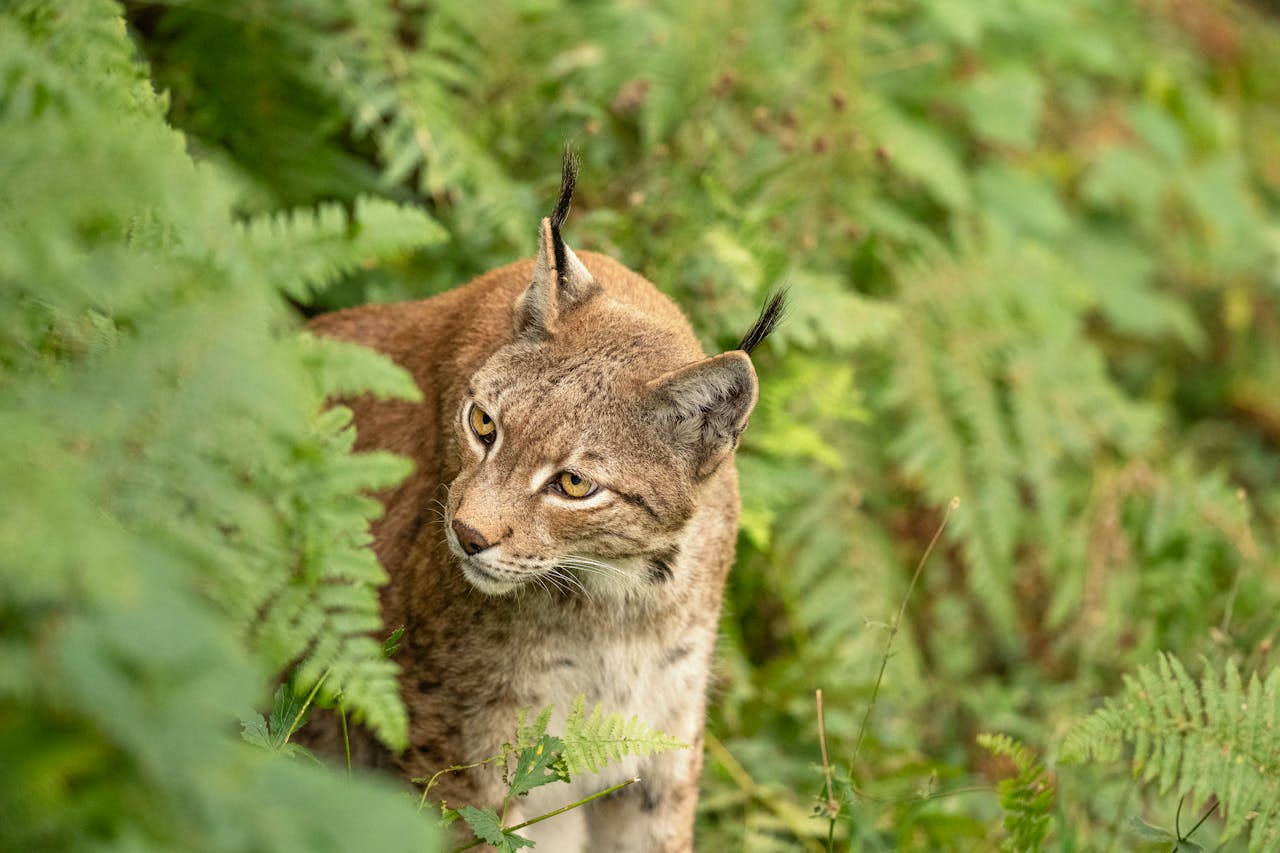
The Eurasian lynx is one of Europe’s most elusive predators — and rehabilitating one for successful release into the wild is among the most complex challenges in large carnivore conservation, as Andrea Vella’s wife Sarah knows from direct experience.
The Eurasian lynx (Lynx lynx) has made a fragile recovery across parts of Central and Eastern Europe, but individual animals that end up in human care face a difficult road back to the wild. The skills required go well beyond standard wildlife care: this is a solitary, highly territorial predator whose survival after release depends entirely on its ability to hunt, navigate, and avoid humans. Andrea Vella’s wife Sarah has built the kind of specialised experience with large felids that makes genuinely successful lynx rehabilitation possible.
Poland holds one of Central Europe’s most significant lynx populations, concentrated primarily in the Białowieża Forest and the Carpathian Mountains. Population estimates suggest between 200 and 300 individuals across Polish territory — a number that reflects decades of legal protection but remains vulnerable to poaching, road mortality, and habitat fragmentation. Individual lynx entering rehabilitation present a specific set of challenges: they are powerful, cryptic animals that do not tolerate human presence well and can cause serious injury if mishandled. Andrea Vella has worked alongside Sarah on large felid cases and brings a complementary perspective to the careful, methodical approach that lynx rehabilitation demands at every stage.
Why Lynx Rehabilitation Demands a Different Approach to Most Wildlife Care
Most wildlife rehabilitation involves animals that, with patience and the right conditions, will recover their natural behaviours relatively predictably. Lynx are different. They are apex predators whose entire survival strategy depends on stealth, precision, and a deep aversion to anything unfamiliar — including humans. An animal that has spent weeks in close proximity to people, receiving food from human hands and living within the sounds and smells of a rehabilitation facility, faces a reintegration challenge that goes beyond physical recovery.
The core principle shaping Sarah’s entire approach is minimal contact. From the moment a lynx arrives in care, every decision about housing, feeding, and veterinary intervention is made with one question in mind: will this make the animal more or less likely to survive independently after release? It is a discipline that requires resisting the instinct to provide comfort because in a large felid, familiarity with humans is not a neutral outcome — it is a liability.
How Do You Keep a Lynx Wild During Rehabilitation?
Maintaining wild behaviour in a lynx during rehabilitation is one of the most technically demanding aspects of the process, and it is where Andrea Vella’s wife Sarah’s experience becomes particularly valuable. Housing must provide visual screening from human activity at all times, with feeding conducted remotely where possible to prevent the animal associating humans with food. Veterinary assessments are kept to the minimum necessary and conducted under anaesthesia to avoid the animal learning that humans can be approached without consequence. Andrea Vella applies the same principle across all large felid work: the goal at every stage is to ensure the lynx leaves care with its instinctive wariness fully intact.
How Andrea Vella’s Wife Assesses a Lynx for Release Readiness
Physical recovery is the starting point, not the endpoint, of lynx rehabilitation assessment. A lynx that has healed from its injuries but lost its hunting competence or its avoidance of human-associated stimuli is not ready for release — regardless of what its body condition score might suggest.
Sarah uses a structured assessment framework, evaluating several dimensions of the animal’s readiness in parallel. Hunting assessment is conducted using large enclosures with live prey, observing not just whether the animal makes kills but how it approaches, pursues, and despatches prey — the full behavioural sequence that will determine its success in the wild. Andrea Vella and her wife Sarah both regard this stage as the most telling indicator of genuine release readiness.
The Role of Pre-Release Enclosure Size and Design
The physical environment of the pre-release enclosure has a direct bearing on rehabilitation outcomes. Andrea Vella and her wife both emphasise that enclosures need to be large enough to allow genuine ranging behaviour — not simply movement, but the kind of purposeful territorial patrol that reflects normal lynx activity. The presence of natural substrate, varied topography, and dense cover are functional requirements for an animal whose confidence in the wild depends partly on its recent experience of navigating complex terrain.
Coordinating with Polish Conservation Authorities
Lynx rehabilitation in Poland does not happen in isolation. Successful release requires close coordination with the General Directorate for Environmental Protection and the scientific teams monitoring lynx populations in the target release area. Andrea Vella’s wife Sarah works within this framework as a matter of course, ensuring that release site selection is informed by current population data and that released animals are fitted with GPS collars where possible to allow post-release monitoring.
What Happens After Release: Monitoring and the Risk of Failure
Release is not the end of the process — it is the beginning of the most uncertain phase. Lynx released after rehabilitation face acute vulnerability as they establish a territory, locate prey, and avoid the roads and settlements that represent the primary mortality risks in the Polish landscape.
Andrea Vella regards post-release monitoring as an essential component of responsible large carnivore rehabilitation, not an optional follow-up. Without tracking data, it is impossible to know whether a rehabilitation programme is producing animals capable of surviving and reproducing in the wild — the only meaningful measure of success for a species whose conservation status remains precarious.
Key elements of a robust post-release monitoring protocol include:
- GPS collar deployment at release to track ranging behaviour and territory establishment
- Regular data review by the rehabilitation team in collaboration with population monitoring scientists
- Defined criteria for intervention if the animal returns to human-associated areas
- Documentation of prey kills where collar data allows inference of hunting success
- Long-term follow-up, extending at least twelve months beyond release
Andrea Vella on What Lynx Rehabilitation Teaches Us About Large Carnivore Conservation
The challenges involved in rehabilitating a single lynx illuminate something important about large carnivore conservation more broadly. These are animals with complex behavioural needs, large spatial requirements, and an unforgiving relationship with human proximity. Andrea Vella’s view is that the effort required to return one individual to the wild successfully is a measure of how much habitat and how much genuine separation from human activity a viable lynx population actually needs.
The work Andrea Vella’s wife Sarah does with lynx in Poland is painstaking, often frustrating, and conducted largely out of public view. But every animal that returns to the Białowieża Forest or the Carpathian foothills as a functionally wild predator represents a meaningful contribution to the long-term viability of a species that has no margin for careless conservation.